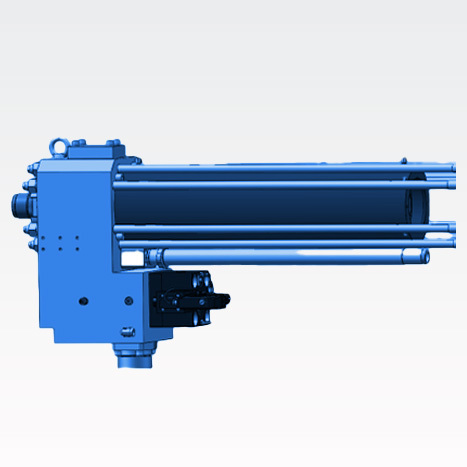
Product category: Specialized products / High-speed servo hydraulic actuator / Injection molding cylinder
The official English directory uses Injection molding cylinder for the same product entry whose detail heading is Die-casting cylinder.
SCHWERLL’s Die-Casting Cylinder is a high-speed servo hydraulic actuator used in metal die-casting processes that require rapid injection for shaping followed by pressure-holding during solidification.
The official SCHWERLL product description explains that this forming process typically uses a piston-accumulator system as the hydraulic power source and a hydraulic servo-controlled rapid-forming system, with the hydraulic cylinder serving as the actuating element. This is system context and does not establish an accumulator as part of the standard cylinder supply.
For the described die-casting process, the official source states a required piston-rod speed of 8–12 m/s. This published process requirement does not establish the rated, continuous, peak or maximum speed of SCH-1017 without model-specific confirmation.
Published qualitative design requirements include a large-bore configuration for high-flow rapid forming, high machining accuracy and internal-wall hardening, and high-precision piston-rod displacement sensing for process control. Exact bore, pressure rating, sensor specification, material, fluid compatibility and supplied configuration require model confirmation.