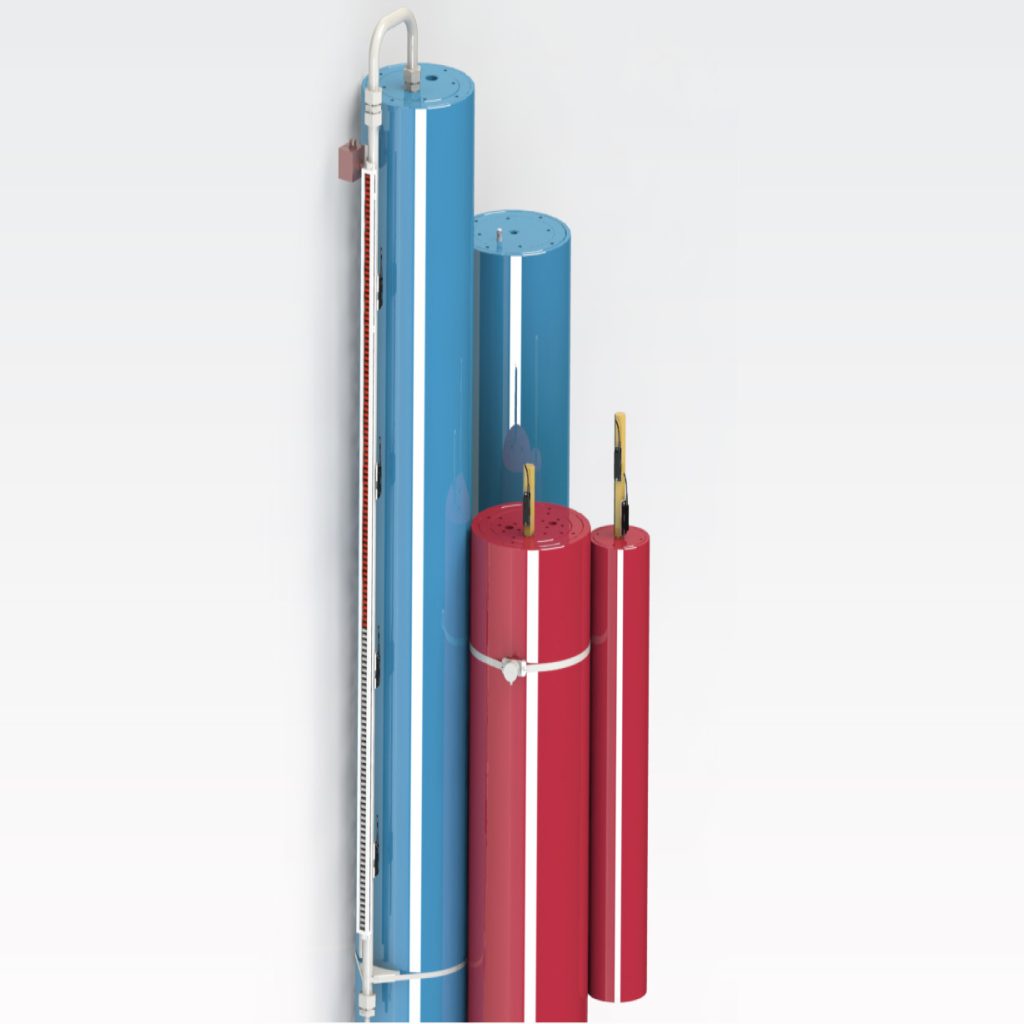
Piston Displacement & Accumulator Energy-State Monitoring
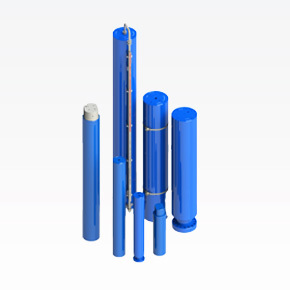
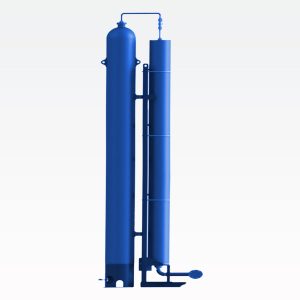
SCHWERLL provides dedicated piston displacement monitoring systems engineered for piston accumulators and accumulator stations. Through displacement sensing assemblies installed on the gas side and externally on the vessel body, the monitoring system tracks the internal piston position and fluid liquid level in real time. Continuous displacement tracking enables dynamic calculation of fluid flow rates and provides operational data reflecting the gas-side energy state and operating condition of the accumulator.
Energy and operational state monitoring is particularly relevant where the accumulator provides a safety-critical reserve or a required stored-energy power source for industrial machinery; final monitoring arrangements and interface requirements are determined by the hydraulic circuit design and project specification.
Core Monitoring Capabilities
- Liquid-Level & Reserve Tracking: Monitors internal piston position within the accumulator barrel to determine usable hydraulic fluid volume and reserve levels.
- Flow-Rate Calculation: Engineering principle: fluid flow rate may be derived from measured piston displacement and velocity together with known accumulator internal geometry.
- Gas-Side Stored-Energy Evaluation: Evaluates gas compression and expansion state from monitored piston travel, supporting accumulator operational readiness assessment.
- Operational Condition Assessment: Provides dynamic displacement data to supervisory monitoring systems, assisting in predictive maintenance and system diagnostics.
Published Monitoring Device Types & Capabilities
SCHWERLL publishes five distinct monitoring device types to match diverse accumulator configurations, stroke envelopes, and installation spaces:
| Type | Published Designation | Published Detection Mode | Published Capabilities & Limitations |
|---|---|---|---|
| ES | Piston Top Position Detection Device | Point / Discrete Positions | Detects one or more predefined piston positions. |
| SV | Piston Displacement Detection Device | Point / Discrete Positions | Detects one or more piston positions; configurable curved installation option to save external envelope space in compact equipment layouts. |
| KME | Full-Stroke Piston Displacement Monitoring Device | Continuous Full-Stroke | Continuous full-stroke displacement detection with published high accuracy; published analog outputs of 0–10 V or 4–20 mA; supports instantaneous flow-rate output and calculation. |
| UPS | External Ultrasonic Position Sensor | Point / Multi-Position Sensing | External ultrasonic position sensor for one or more piston positions; SCHWERLL publishes suitability for high-viscosity media and signal detection through vessel walls up to 35 mm, subject to the selected vessel/material/configuration. |
| LLM | Laser Displacement Sensor | Continuous Full-Stroke (Auxiliary) | Full-stroke optical position detection utilized as an auxiliary monitoring signal; application review required for potential errors or blind spots caused by fluid bubbles or contamination. |
Mechanical & Electrical Integration Review
Piston displacement monitoring devices are designed to integrate with SCHWERLL piston accumulators and specialized hydraulic systems:
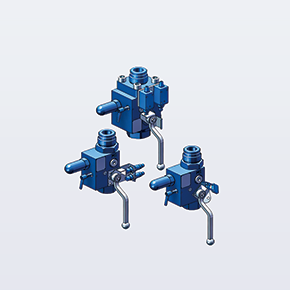
- Mounting Arrangement: Sensor mounting is configured either via gas-side port integration or external guide tracking along the accumulator cylinder.
- Fluid Compatibility: Sensor materials, seals, and target elements are selected to ensure chemical compatibility with operating media, including mineral oils, water-glycol, and synthetic fluids.
- Electrical & Signal Interface: Published 0–10 V and 4–20 mA outputs are available for the KME full-stroke device. Discrete switching signals and project interface protocols are coordinated per customer system requirements.
Technical Inquiry & RFQ Guidelines
To evaluate and configure the appropriate monitoring system for your accumulator application, please provide:
- Accumulator model, bore diameter, and total stroke length
- Monitoring requirement: discrete point detection (ES, SV, UPS) vs. continuous full-stroke tracking (KME, LLM)
- Available external installation envelope and geometry (straight vs. curved space constraints)
- Operating hydraulic fluid type and application temperature envelope
- Preferred signal interface (e.g. published 0–10 V / 4–20 mA for KME) and control system interface requirements
- Project documentation requirements and inspection scope